
Quebec out over its skis on electricity exports
Consecutive dry years have exposed risks of an export-heavy economic bet

Hydro-Quebec and its partners energized a major transmission line into the U.S. last week under the province’s 2023 plan to increase exports as “North America’s leading supplier of clean energy.” However, low water levels and anticipated domestic demand could mean that Quebec has made more export promises than it can easily keep.
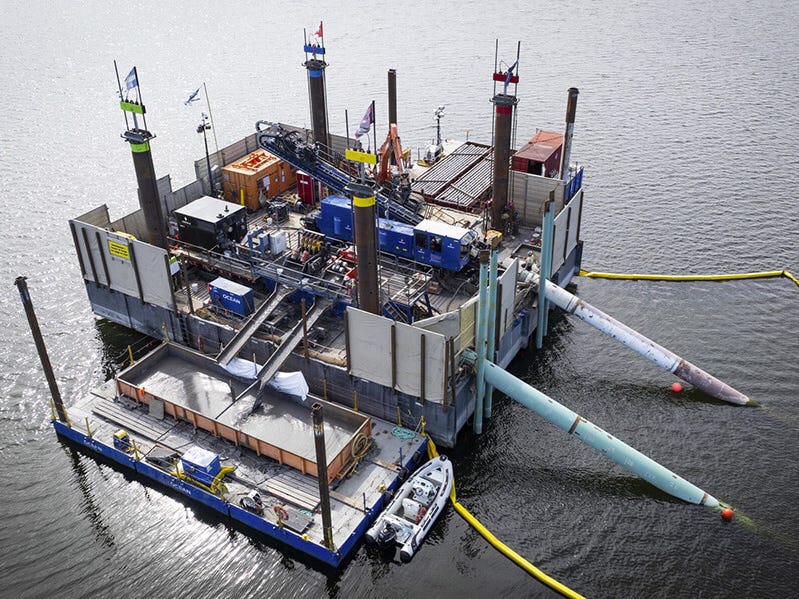
The Appalaches-Maine line is set to deliver 10 terawatt hours (TWhs) of clean Quebec electricity per year for 20 years. Boston will get 9.45 TWhs with the last bit going to Maine. Hydro-Quebec also signed a long-term 10.4 TWh/year deal to supply power to New York City via a separate transmission line. Deliveries to New York are slated to start later this year when the line is complete.
Historically, these export deals would be all upside for the province. From 2018-2022, Hydro-Quebec exported more than 32 TWh of electricity annually. The province produced inexpensive power from large hydro resources and sold electricity to its neighbours at higher rates, earning $2.9 billion in 2022 revenue alone. In this context, signing 20 TWh/yr in supply deals with New York City and Boston was a no-brainer.
However, the picture has changed since 2022.
The dry years
Consecutive dry years have resulted in lower water levels and decreased hydro power production. Hydro-Quebec exported just 23 TWhs in 2023, 15.1 TWhs in 2024 and only 8 TWhs in the first nine months of 2025 (compared to 11 TWhs over the same period in 2024).
The export decline was not because its neighbours lost interest in power purchases. Ontario is managing potential shortages while its nuclear fleet is refurbished. New York’s wholesale rates were higher in 2024 than they were in 2018-2021, indicating that low-cost, clean electricity was still very much in demand there. Quebec would have benefited financially from increased exports in 2023 onward but didn’t have more to sell.
Since 2023, Quebec has been a net importer of electricity. HEC Montreal, which publishes an annual report on the province’s energy sector, said that Hydro-Quebec imported 36 TWhs in 2023. In that year, it sold just 23 TWhs to its neighbours (see below). So, some of that imported supply was to meet its own needs.
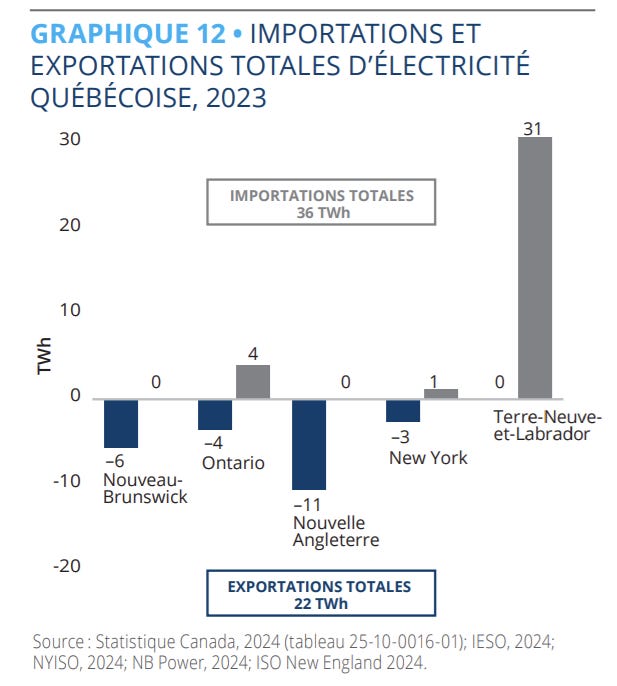
The gap between imports and exports widened in 2024, according to Hydro-Quebec’s annual report. And, it said in its November update that it had been a net importer again in 2025.
Further indications that Quebec might have overextended itself with these new deals is that, despite buying more power than it’s selling, Hydro-Quebec’s reserves have declined steadily since 2023.
Shrinking security net
Quebec’s hydro reservoirs provide insurance in meeting its own citizen’s needs and complying with supply deals. In 2021, the reserve had been as high as 154.9 TWhs, which was not far off it being able to meet the province’s entire electricity needs for a year. Impressive – most markets don’t have that luxury.
However, the reserve has been diminishing since then and was forecasted to start 2026 at just 86.9 TWhs. The level would be the lowest since 2004 and only about half of Quebec’s domestic requirements: still representing a comforting multi-year buffer against blackouts but potentially a red flag for future export deals.
It’s a tricky time to kick-off two new 10 TWh export deals. Quebec, which has said it will adhere to its export commitments, has started to make changes to provide itself some breathing room.
Adjusting to reality
The province appears to be betting that slowing things down until 2035 is all it needs to get back on track.
Last week, the province pushed back its commitment to reduce emissions 37.5% below 1990 levels to 2035, instead of 2030, citing economic challenges and its neighbours’ poor performance in this area. This could allow the province to slow its electrification efforts, via which it intends to reduce transportation and building emissions. By slowing electrification, it could ease domestic strain on its power reserves in the next few years.
Hydro-Quebec also approved the proposed conversion of a 350 MW plant to use Renewable Natural Gas (also called biogas) to provide electricity during periods of peak demand beginning in 2029. And, it plans to launch a call for wind power proposals this spring for projects smaller than 350 MWs that could provide power by 2035.
Quebec signed an MOU with Newfoundland & Labrador in 2024 under which it could have long-term access to nearly 4 GWs of new hydropower (less Labrador’s needs) at affordable rates. The final deal is expected in April. It is possible the power available to Quebec under the final agreement will be considerably less than 4 GWs but whatever the province secures should provide a significant boost to reserves when the hydropower projects come online after 2035.
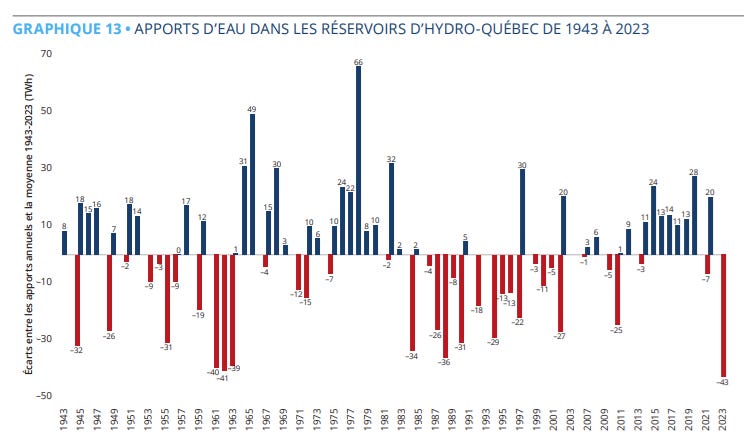
The province has reason to hope that the dry spell will end. Quebec has seen low-precipitation years come and go (see below - red are the dry years). Shortage concerns could disappear after a few years of decent water levels, like in the 2010s. The risk here is the unpredictability of climate change, which could just as easily prolong the dry spell beyond what Hydro-Quebec has faced since the 1980s and 90s.
Either way, Quebec’s plan of being the powerhouse of North America has been proven a risky bet if the province isn’t careful about overextending itself. Electrification does not mix well with multiple dry years in a hydropower dependent market. And, Quebec still has to factor in anticipated AI data centre and mining power demands – a topic it has been cautiously dodging.
Neighbouring jurisdictions would do well to take note and not assume they’ll be able to rely on imports from the clean energy giant beyond what it has already committed.