
Ontario to enable renewables with global first LDES procurement
But could outpace anticipated LDES technology cost reductions

Ontario has signed nearly $10 billion in battery storage contracts and will be the first electricity market to seek bids solely for non-battery long-duration energy storage (LDES) later this year.
Storage capable of delivering more than ten hours of continuous electricity (long-duration) is a key enabler of renewable energy but is beyond most batteries’ capabilities. Ontario is looking to purchase 800 MWs of this LDES capacity from non-battery alternatives like pumped hydro storage (PHS) and compressed air energy storage (CAES).
This is good news for adoption of non-emitting power and it is encouraging to see Ontario diversify its storage resource mix by adding LDES to its anticipated 3.2 GW of lithium-ion batteries. The only question is timing. Ontario is a relatively small market on the international stage and may be outrunning expected cost reductions.
The science behind PHS and CAES is established but there have been relatively few projects built globally. The accelerating wind and solar boom has created a significant need for long-duration storage, which has kickstarted global development. PHS and CAES capital costs are set to fall considerably as related expertise and manufacturing capabilities ramp up. Ontario may miss out on the savings.
Renewables on Ontario’s grid
Ontario needs LDES resources on its grid. The province’s market administrator, IESO, has said that it anticipates electricity demand will increase by 75% by 2050 and, as its estimates are always understated, it’s safe to assume demand will at least double.
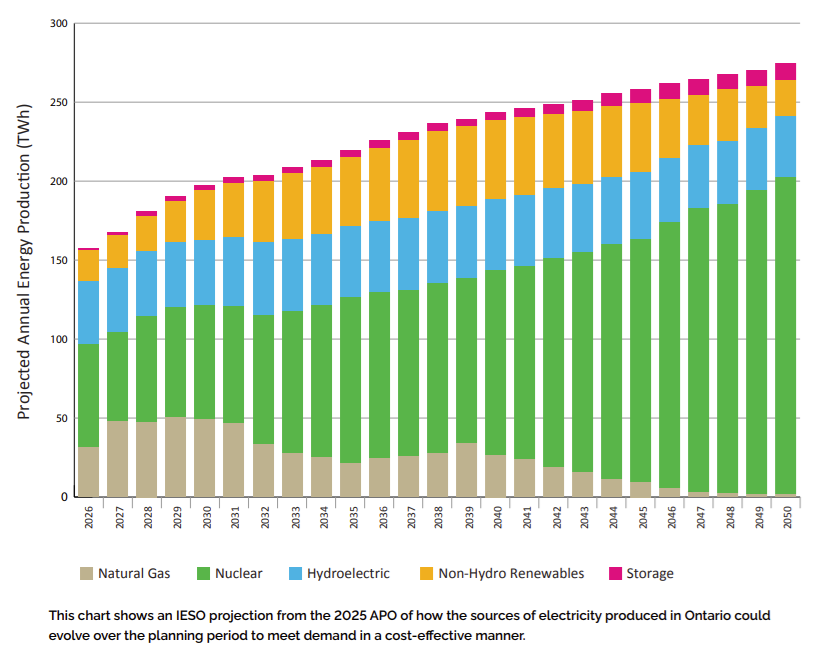
Under current government direction, IESO anticipates a dramatic reduction in wind and solar energy’s role on the grid by 2050 with nuclear power making up the difference, but that doesn’t have to be the case. Renewables are cheaper and create no radioactive waste - they could continue to play a major role on the grid if properly backstopped.
Wind and solar have not historically boasted strong capacity factors, i.e., the amount of electricity an asset produces in a given time compared to the amount of electricity it would produce if it was pumping out power at max capacity. This has stumped grid planners and under-pinned anti-renewables political positions.
The tech has been improving rapidly. Land-based wind built today has a capacity factor of over 35% and wind turbines built in waters off the coast boast much better numbers. Solar still lags but is improving as module trackers (which follow the sun) and two-sided panels are implemented.
Paired with LDES, renewables’ capacity factors would surpass gas and hydro power, with zero emissions and with less environmental impact. Renewables are also immune to spikes in global gas prices and the droughts plaguing Manitoba and Quebec’s hydro reservoirs in recent years. Adding LDES could help the province shutter gas generation long before 2047 and could limit the need for expensive new nukes.
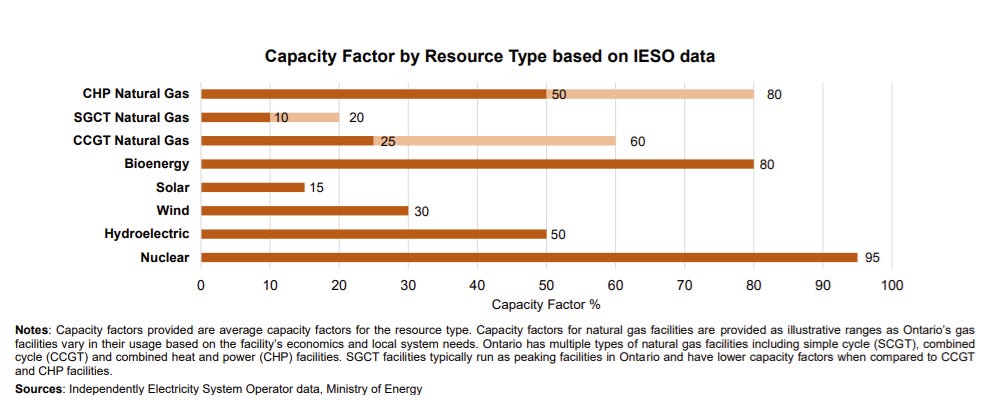
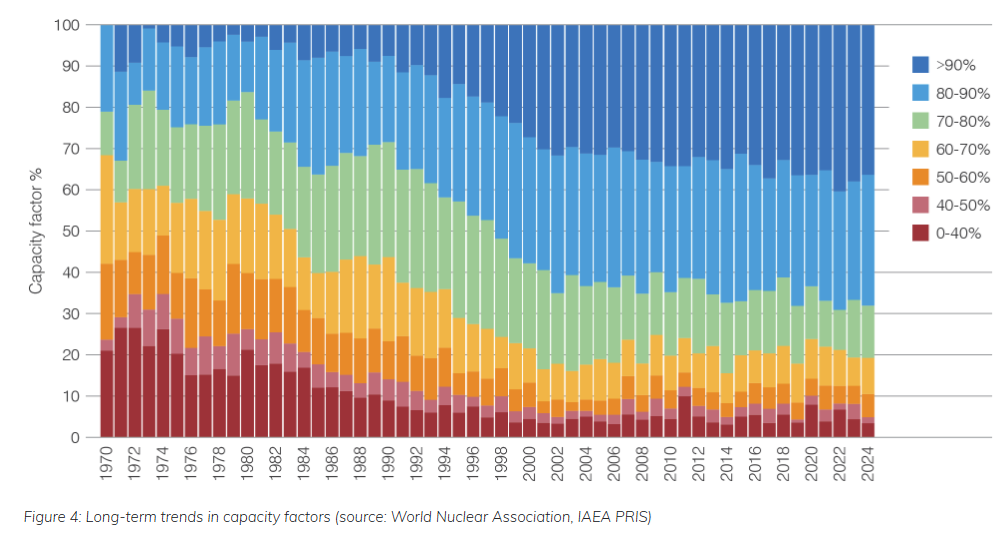
Even if nuclear does rule the day, it is prudent to have some LDES on Ontario’s grid. Ontario claims nuclear power has a 95% capacity factor but that is based on the best results of one of our reactors and is inconsistent with decades of poor performance and outages. Production is improving for traditional nuclear power but that is partly the result of refurbs. No one knows how SMRs will perform.
LDES in hot demand
PHS and CAES are established technologies with specific constraints that have made them a last-resort option for grid planners. This unfavourability has limited development of an equipment supply chain and global expertise, which has kept costs artificially high. These constraints still exist and will continue to hamper potential development but LDES is so important to a low-carbon future that the market is growing anyway.
Pumped Hydro Storage
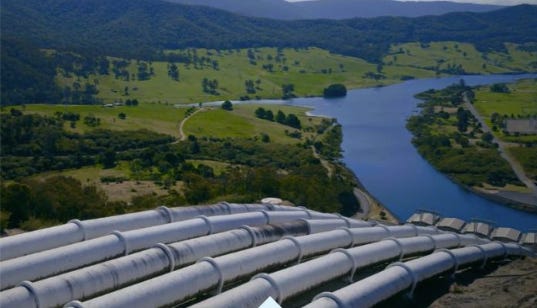
PHS is exactly what it sounds like. A reservoir is built at a higher elevation than a large water source. When there is excess electricity on the grid, the project uses that power to pump water from the source, up a pipe, to the higher-elevation reservoir. When the grid needs power, the water is sent back down to a turbine to generate electricity.
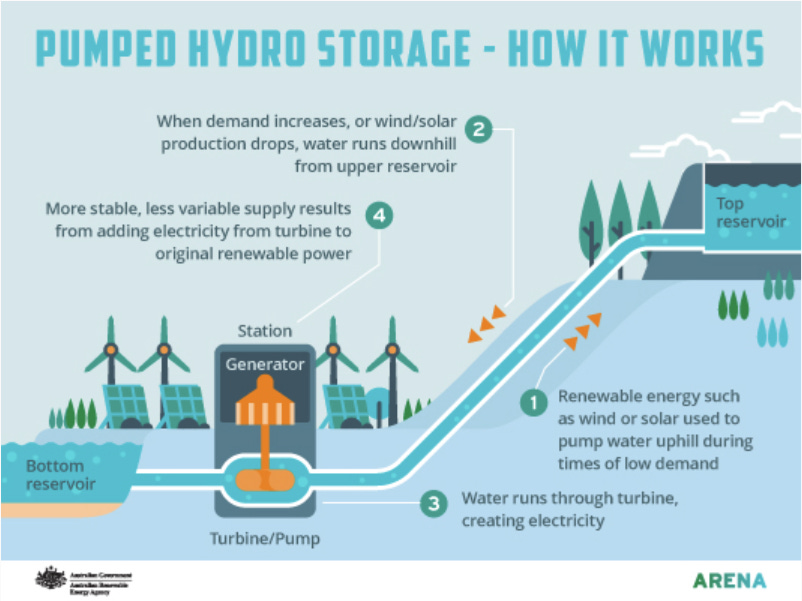
PHS needs a significant water source, a nearby elevated feature, and a higher-elevation reservoir. These projects can significantly impact the environment and it can be expensive to compensate for geographical shortcomings. The Ford government has already invested $285 million in the early-development of one such project owned by TC Energy, despite IESO’s warnings that the project was too expensive.
Compressed Air Energy Storage
CAES is similar but with air. When there is excess power on the grid, a compressor uses the electricity to capture air and store it in underground caverns. When the grid needs power, the compressed air is released to power a turbine.
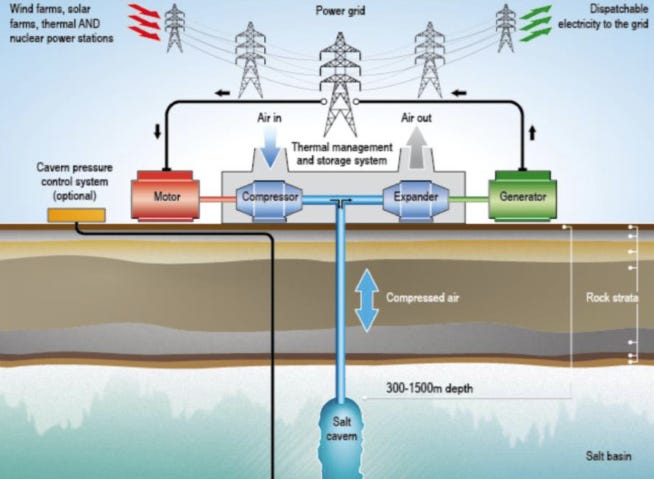
CAES needs underground caverns (which can be artificial) and a heat source. The air expands as it is released which requires something (usually gas-fired electricity) to heat it back up so the turbine doesn’t freeze. Newer plants capture the heat created when the air is being compressed and use that to reheat the air later on (A-CAES). The tech is emissions-free but still developing and more expensive.
There are just two significant CAES projects in operation globally, in Germany and Alabama. A handful of A-CAES projects have been announced in China, California and elsewhere, which will foster supply chains and reduce costs – one study estimated 15% annually. But, the world is still early in this process. Most companies indicating interest in Ontario’s procurement have never built a full-scale operating project.
Ontario
Finding the necessary natural features is difficult, and finding them near transmission is very difficult. Ontario has some underground caverns, lots of lakes, and changes in elevation, but even here, development options are limited.
Global procurements and economies of scale
A few much bigger electricity markets than Ontario have held or announced plans for “long-duration” storage procurements though most sought projects capable of delivering just eight hours of continuous power. Australia awarded 2.2 GW in contracts to one PHS and eight battery projects. Italy awarded all of its contracts to battery projects capable of providing up to 8-hours of continuous power. And, Germany is planning 2 GW in procurements for 10-hour natural gas and battery storage later this year.
The UK and New York are leaving their procurements open to any established long-duration technologies, including PHS and CAES, but their 8-hour power delivery target could see lithium-ion batteries dominate those procurements as well. Results are due out later this spring for both.
China, of course, is leaving the rest of the world in its dust with eleven 100 MW A-CAES projects started in 2024 alone, establishing a supply chain and almost single-handedly reducing the tech costs. It is reasonable to assume those markets listed above will eventually follow China into large-scale A-CAES and PHS development - they allowed for it in procurements and they’re taking other steps to foster growth - but big cost reductions may be years out.
IESO has adopted an undisclosed “Reserve price” that it will use to cap potential costs under the procurement. And, there could also be supply chain benefits to being an early adopter. For example, leading A-CAES tech developer Hydrostor is Canadian. Being early might be worth a little extra cost with complementary supply chain investments from the government.
However, Ontario is also out front globally on incorporating SMR technology, which is also not yet benefiting from economies of scale. The province has taken a lead position on these emerging technologies without a planning rationale or energy mix scenario analysis on why it is buying these particular technologies or why it’s important for Ontario to be a global early-adopter.