
Feds to increase interprovincial links by 70%
Electricity strategy offers money and, for some reason, federal intervention

Prime Minister Carney hopes to unlock tens of billions in electricity investments by boosting interprovincial transmission capacity 70% by 2050. Canada could exceed the target and lessen reliance on U.S. markets if Carney can resist the urge to fix the provinces’ problems for them.
The electricity plan includes previously announced tax credits, grants and debt financing, all of which can be tricky to qualify for but reduce the risk of developing new transmission. Carney also referred the interprovincial intertie strategy to the Major Projects Office. The MPO doesn’t have a track record yet but the move indicates a commitment to ease a siting process already complicated by regulations in multiple provinces.
So far, so good.
The electricity strategy also aims to establish a cost-allocation framework like the European Union’s Projects of Common Interest (PCI) and to establish long-term planning and dispute resolution mechanisms. It’s here that the Feds risk derailing progress.
My precious
Canadians watching our provincial governments fail miserably to free up national alcohol sales would hardly be surprised by limitations in electricity trade. The provinces have different market structures and planning capabilities, and several are dealing with grievances under existing power deals.
These issues have slowed interprovincial transmission development and left existing connections underused. While some regions hope to export more electricity to their domestic neighbours, none seem keen to increase imports in their long-term plans. Like alcohol, the reluctance to import power from each other is not due to technical barriers or even a broader aversion to importation.
All the southern provinces have robust transmission interties with their neighbouring U.S. states and are actively expanding those connections or planning to, even where the electricity they import from the States would be dirtier and/or costlier than electricity imported from elsewhere in Canada.
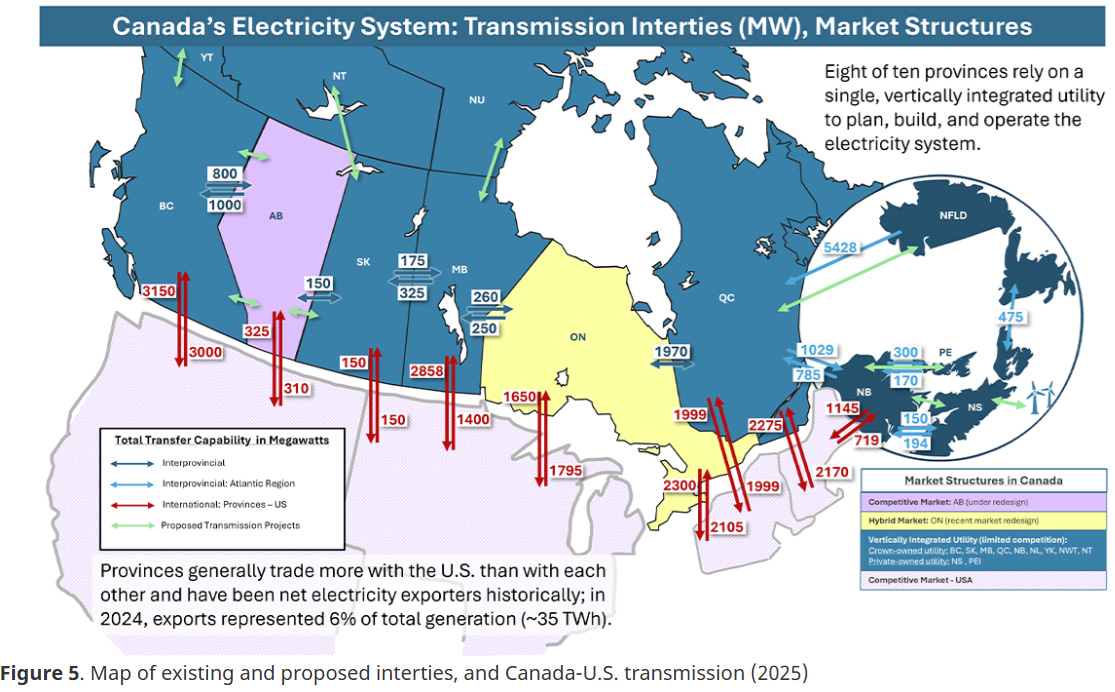
The provinces have each consistently minimized domestic imports and limited their counterparts’ influence over their electricity systems, which they jealously protect in a show of provincial independence. Think Gollum and his ring.
The Feds are correct this has to change for Canada to reduce our reliance on U.S. markets for economic and electricity security. The Feds are wrong to think they can play peacemaker. Every foray the federal government has made into electricity regulation has been met with appeals to the Supreme Court and threats of the Notwithstanding Clause.
Federal intervention in electricity spats would have to be fairly sure of its outcome to justify the provinces’ potentially extreme reactions.
Cost-allocation schemes not a cure-all
A truly predictable cost-allocation framework sounds like a goal for which the Feds might understandably risk stepping on some provincial toes. Trouble is, no one has found a way to make one work.
The E.U.’s PCI framework considers each country’s long-term transmission plan with distinct scenarios, which are analysed in light of a proposed intertie to determine net benefits and to decide if the project is worthwhile. The analysis should serve as the basis for cost-sharing but the E.U. hasn’t had any takers.
The Centre on Regulation in Europe (cerre) found last year that the inherent uncertainty in long-term outlooks and the variation in member countries’ planning meant that most projects relied on a simple 50-50 cost split. In other cases, countries paid for infrastructure installed within their national borders.
The U.S. Federal Energy Regulatory Commission’s (FERC) framework for interregional transmission is similar. Most cost sharing arrangements continue to be based on transmission usage or the location of the equipment, despite a detailed process for analysing net benefits and cost-allocation, the Department of Energy found earlier this year.

Even if the U.S. and E.U. solved the cost-allocation puzzle, Canada’s is a much smaller electricity market. Long-term planning is a mess in most regions and is non-existent in others, so it is unlikely provinces would be capable of meaningful participation in an E.U.-style framework set up by the Feds.
This is an A-B conversation…
A dispute resolution mechanism would certainly have plenty to deal with in Canada but the question facing the Feds is whether or why the provinces would submit to it.
British Columbia has abundant clean, cheap hydro resources. Alberta needs clean, cheap power. A match made in heaven? Apparently not. There is already more than 1 GW of transmission between the two provinces that Alberta has either declared unusable for vague technical reasons or simply refused to draw on even during massive surges in demand, which has frustrated BC.
Similarly, Newfoundland & Labrador is home to the massive Churchill Falls hydro plant and is hoping to negotiate a fair supply and transmission deal. Quebec needs the power but has options and is willing to wield its economic might. Newfoundland needs to cross Quebec to sell power it can’t consume internally or send to Nova Scotia and has been burned before.
The Canadian Energy Regulator could intervene quickly. It exists and ostensibly has authority over interprovincial transmission lines. It is not clear though, why the provinces would be any more open to this federal intervention in their electricity kingdoms than they have been on carbon pricing.
Alberta may worry the Feds will prioritize Canada’s climate concerns over the province’s reliability issues. Newfoundland may see the federal government a large negotiator not fully invested in its economic success when it’s already battling one such entity. The Feds may strain crucial relationships trying to push their way in, all to be ignored in the end as provinces settle their disputes slowly and painfully in their own way.
Federal money and a permitting speedway, undoubtedly helpful. An electricity daddy shoving in to “fix” things, probably not.