
Ontario antes up for a massive mining bet
New transmission line is the first move in a multi-billion-dollar northern play

Ontario moved the 230 km Greenstone Transmission Line toward construction in late-January, an easy start to a series of roads and transmission investments it expects will unlock $22 billion in economic gains tied to a northern mining opportunity.
Hydro One will connect the 230 kilovolt (kV) line to the East-West Tie in Nipigon, roughly 115 kms northeast of Thunder Bay. Greenstone Transmission will then run northeast through Longlac to Aroland First Nation. It will enter operation in 2032.
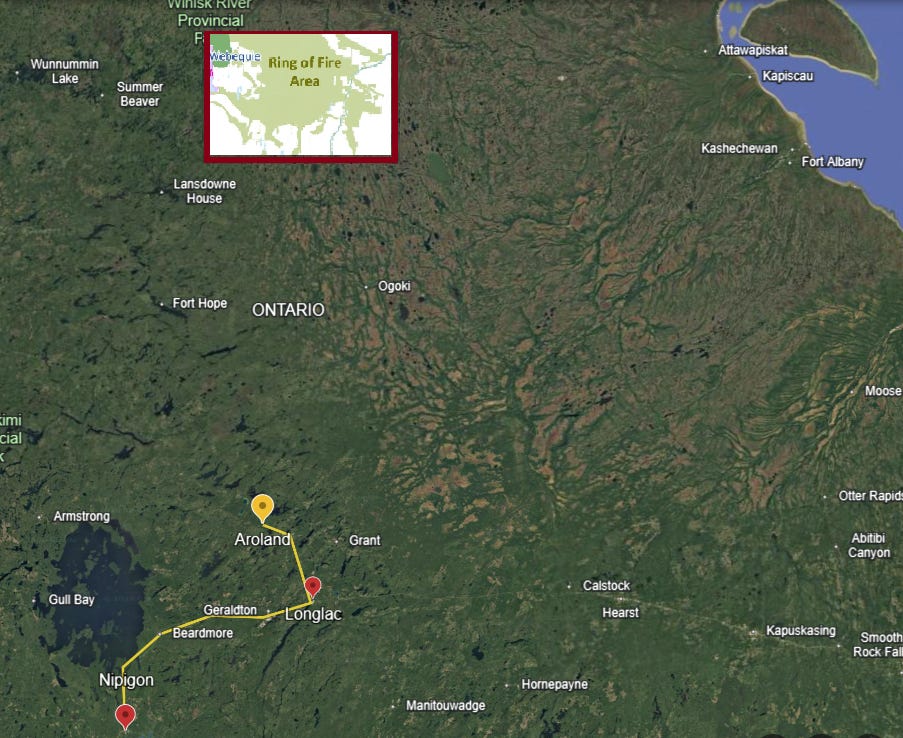
Market administrator IESO recommended a shorter version of the line for construction at about $70 million in 2015. In today’s dollars, and considering the longer route and technical details, the line could cost at least $150 million. The spend is significant but the line will help meet existing needs in the area. So, it is a safe opening bet in a series of infrastructure investments aimed at providing access to a mineral rich region 300 kms north of Aroland called the Ring of Fire.
The question is whether the Ontarians have the stomach for $2.5 billion+ in additional speculative infrastructure investments to tap into a region where there is currently just one advanced project still years away from mining production.
The opportunity
As annoying as the name is, and it is very, the Ring of Fire could provide up to 70,000 jobs and $22 billion in economic gains for Ontario, the government says. It believes the region has significant mineral deposits waiting to be pulled out of the ground and processed domestically by Canadian workers, as the country looks to onshore its supply chain in response to U.S. antics.
There are several open mining claims but only Wyloo’s Eagle’s Nest project has completed preliminary feasibility and environmental assessments. The project would mine nickel, copper, and platinum group metals, all of which are extremely valuable in today’s low-carbon and data centre-heavy economies.
Mining projects can take 15 years or more to move from exploration to production. The provincial and federal governments are working to shorten that timeline but even a wildly accelerated process would need 10 years. This buys Ontario a little time to build the necessary infrastructure for mining production if it starts right now.
The need
The area between Webequie First Nation and Attawapiskat First Nation, and south to Hearst has not been developed significantly, as compared to the regions further south or to the west. There are no all-season roads or continuous electricity infrastructure north of Aroland. First Nations communities are accessed by plane and by ice roads in the winter, though climate change has dramatically shortened the ice road season in recent years. Diesel is a common power source.
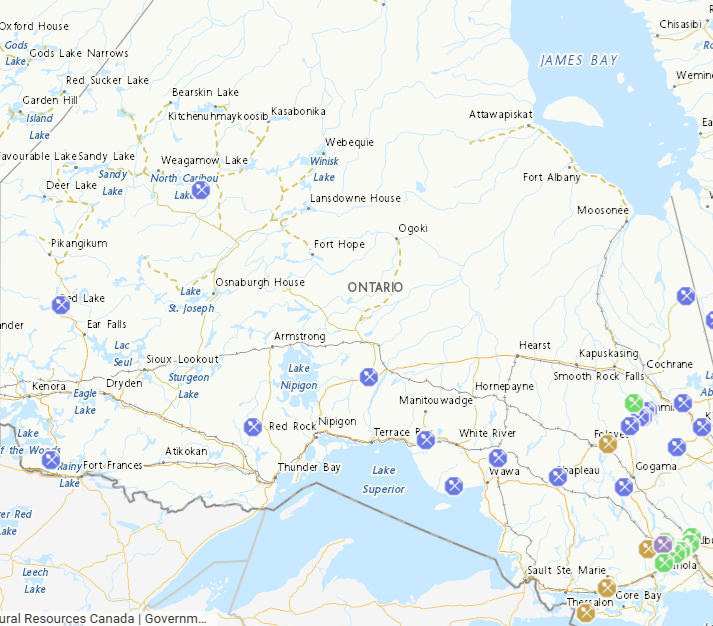
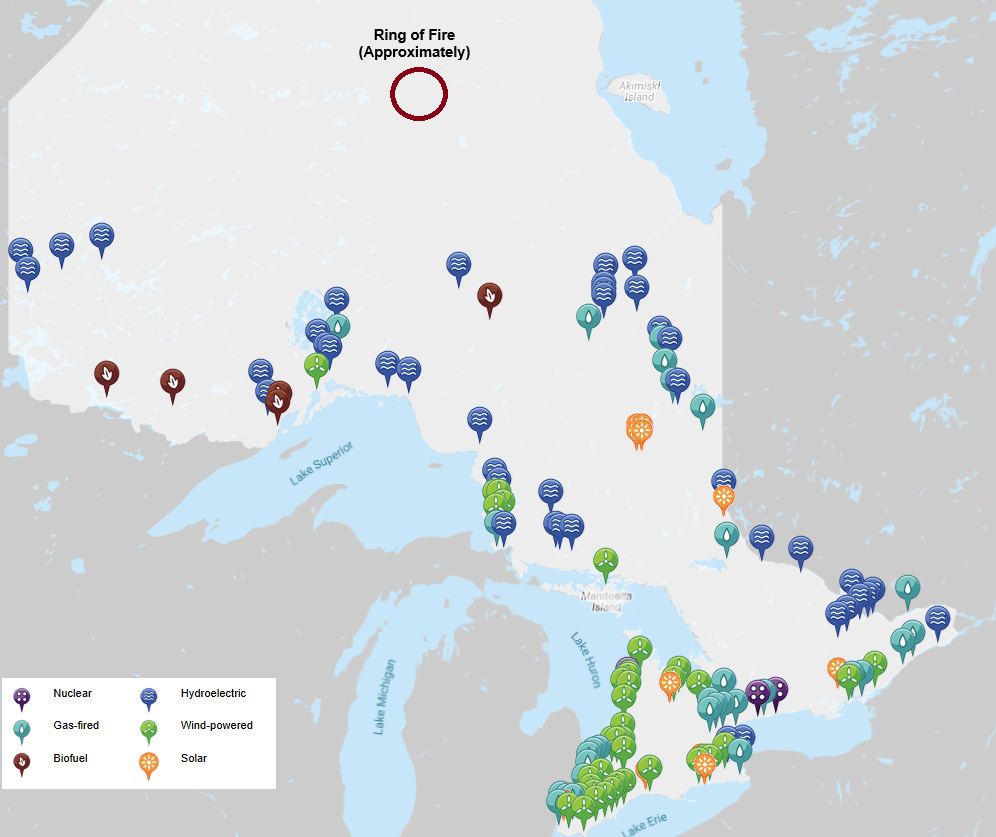
Any future mines would need all-season roads to move heavy machinery, people and ore. They would also need power to run their operations. Unfortunately, all the existing hydro power in the region is well south of the Ring of Fire and there is no transmission to carry wind, hydro, or solar power around the region.
Some have suggested that mining operations could build their own small module reactors (SMRs) or other power plants onsite, and it’s possible. Building SMRs or other electricity generation near a mine would limit the need for transmission. However, it would complicate operations and raise the cost of building new mines in northern Ontario as compared to other jurisdictions, to which mining companies would likely turn.
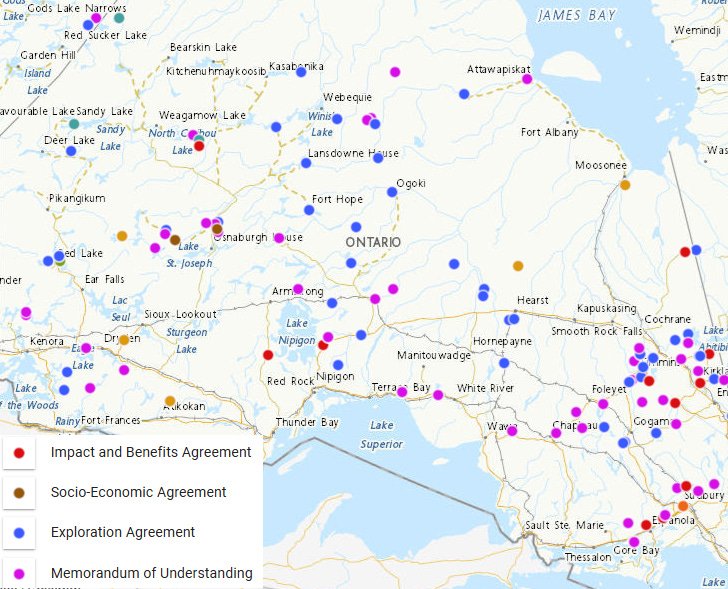
And there is interest in Ontario the government is hoping to foster. The map below is of active agreements with First Nations in the region, a first step in exploration and subsequent development. Few companies have strayed far from existing infrastructure but the possibilities are drawing early interest into the Ring of Fire and neighbouring areas.
The plan
The government aims to pre-build the infrastructure needed to convert that early interest into productive mines. Greenstone Transmission is the first step in this plan. Hydro One will build the line along existing highways. Simple enough.
The next steps are more expensive and complex but could move quickly if the province decides to go all-in on its vision. This includes 550 kms over four roadwork projects:
Upgrade of the Anaconda and Painter Lake logging roads north of Aroland,
A new 230 km road to the Martens Falls First Nation,
A new 200 km Northern Link to the Ring of Fire, and
A new 120 km supply road to the Webequie First Nation.
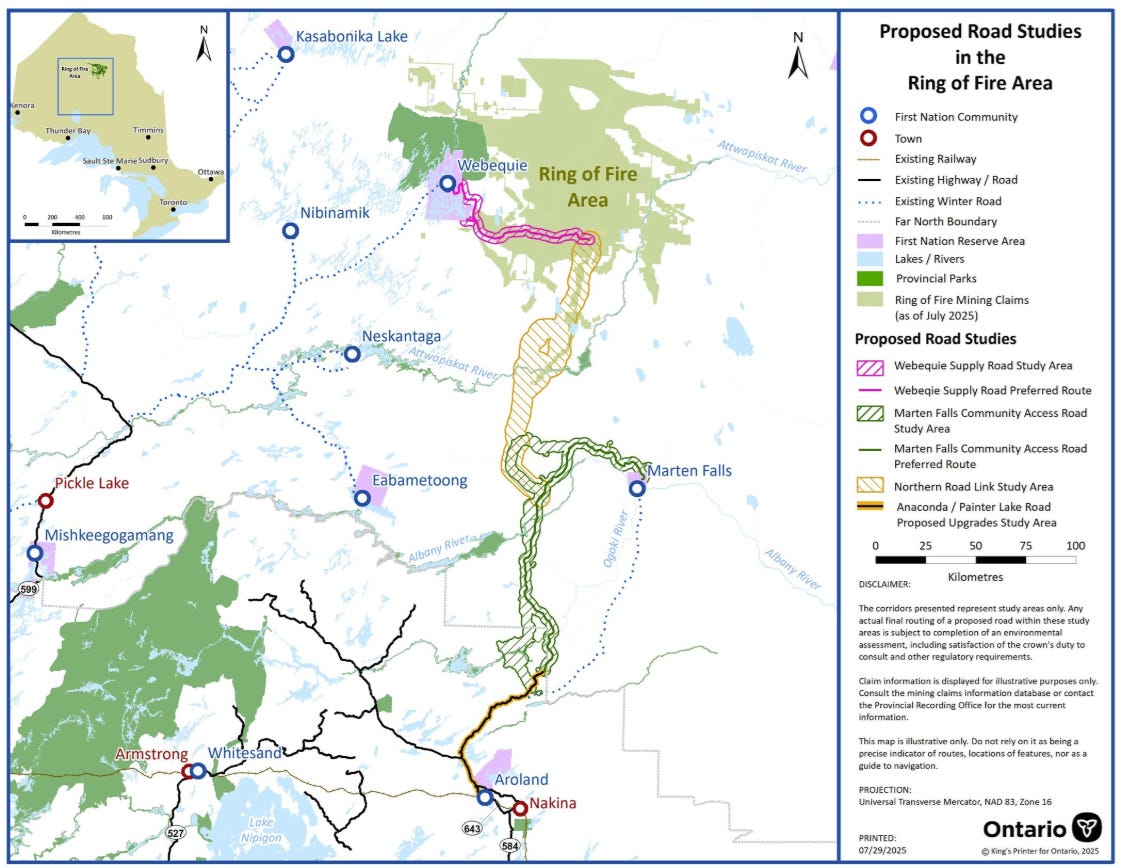
The province has not disclosed anticipated costs but early plans estimated a $2 billion price tag. A 2019 study by research board Northern Policy evaluated recent roads projects in Ontario’s north that could indicate a smaller spend, though they didn’t evaluate roads anywhere near as extensive as these projects.
The roads projects are headed by the First Nations on whose lands they would be built and consultation with other impacted Nations is ongoing. All four projects have final environmental assessments out for public comment or about to be released, and could reach final decisions in the near-future.
Assuming the roads projects move to construction, they could provide an easy route for the remaining transmission needed to connect Aroland and Webequie. IESO has not yet studied such a line, other than to note in 2015 that mining companies could pay for the line if they wanted one. However, such studies could easily be undertaken in the next few years alongside the roadwork.
The distance would be 100 kms longer than East-West Tie but, presumably, a single circuit, so could be comparable to its $777 million cost in 2024. All in, the roads and transmission projects could cost about $3 billion or more over 10 years to open potentially many times that amount in mining opportunities and to connect First Nations increasingly isolated by diminishing ice roads.
Transmission in the area could also enable wind and solar energy projects to contribute to the region’s power grid, further mining, and other economic opportunities. These could provide additional independent revenue sources for the First Nations living there.
The challenge
Canada does not generally take a “if you build it, they will come” economic approach, with the notable exception of the Canadian Pacific Railway. British Columbia has committed to reinforcing an existing major transmission line based on its expectation of future mining and data centres but that’s uncommon and not wildly popular.
Canada is not a high-risk, high-reward kind of country. We’re careful and conservative, and it’s mostly served us well. However, as Prime Minister Carney said in Davos, “Canadians know that our old, comfortable assumption that our geography and alliance memberships automatically conferred prosperity and security is no longer valid.”
The metals and critical mineral resource is likely significant in the Ring of Fire and relatively undeveloped area to the east, there is considerable interest from mining companies in light of soaring market prices, and the First Nations in the region appear to be eager to make economic use of their land, subject to careful planning and consideration.
But, there is still only one advanced mining project in the Ring of Fire and no investment guarantee. Beyond the Greenstone Transmission Line, there are no safe bets.