
Canada must reconsider uranium enrichment
Post-rupture, domestic enrichment could be a prerequisite for SMR development

Prime Minister Carney read aloud many Canadians’ inner thoughts when he said at Davos, “We are in the midst of a rupture, not a transition.”
Canada must now examine all the ways in which we are intertwined with the U.S. to determine where we can remain integrated and where we need to split. Canada’s nuclear pathway should be a priority in this reconsideration.
Canada has been able to avoid hard questions about national security when it comes to our nuclear power fleet because all our operating plants use the CANDU reactor. The heavy-water reactor uses uranium dioxide, which does not require enrichment and which we make in Canada. The technology is old but could potentially be updated for new large nuclear reactors.
Problem solved, right?
Nope. Ontario, Alberta and other provinces are interested in small module reactors (SMRs). Alberta hopes they will power its $100 billion AI industry dream. Saskatchewan is hoping to finally shutter its coal-fired power. And, Ontario recently approved $7.7 billion to build a single 300 MW SMR, which it imagines will foster a nuclear tech sector in the province.
SMRs are light-water reactors that consume enriched uranium, which we do not produce domestically and which the provinces plan to source from the U.S.
Canada has two choices if nuclear is to be part of our energy future without eroding national security:
1. Forget SMRs and focus resources on updating the CANDU reactor technology.
2. Allow SMRs into the mix but establish domestic enrichment facilities capable of producing the low-enriched uranium (up to 5%) and/or high-assay low-enriched uranium (up to 20%) needed to fuel them.
Any other nuclear pathway could leave Canada additionally vulnerable to foreign coercion as provinces would rely increasingly on imported enriched uranium to meet electricity needs.
Uranium in demand
The threats and actions the U.S. has levelled against Canada in the past year were for ridiculous, made-up reasons. Additional American control over Canada’s energy supply could further enable such inexplicable behaviour even without increasing pressure in the nuclear sector.
However, heated competition for uranium resources is likely on the horizon. Nuclear power is set to play an increasing role in powering the AI market, an area of intense global competition. The OECD’s Nuclear Energy Agency expects that nuclear energy demand could triple by 2050.
The NEA expects demand to outpace mining production by 2040, even assuming all existing, idled, planned and prospective projects and all inferred resources are mined. This is a big supply assumption that would require significant investment.
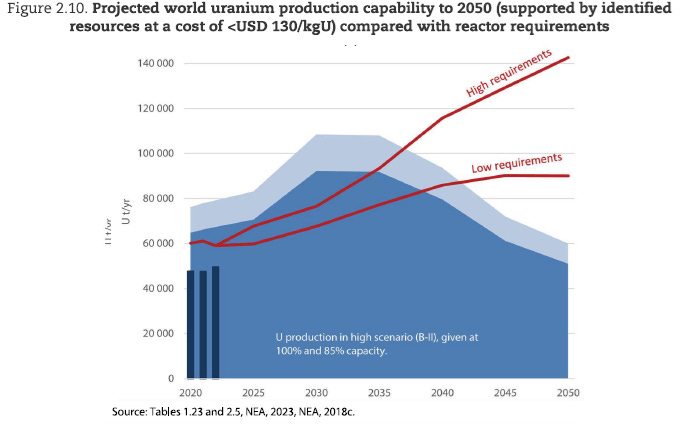
NEA expects a shortage if mines are operating at 100% (the light below colour) though they’re more likely to operate closer to 85% (dark blue). Some of this gap could be made up by secondary supply but countries will be competing for limited resources, which could also mean higher prices.
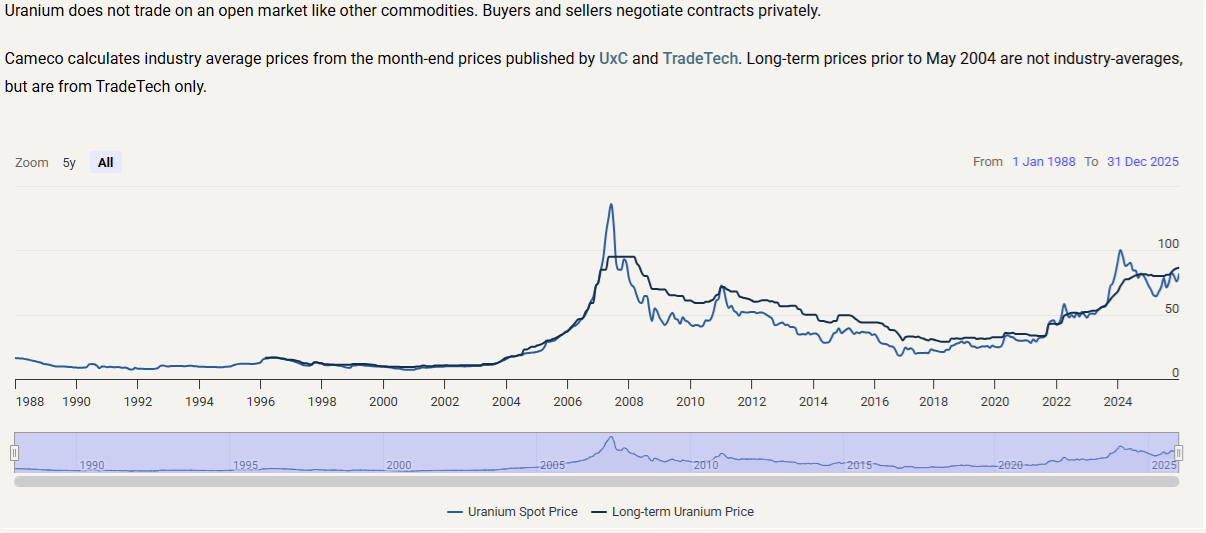
Canadian uranium miner and processor Cameco tracks uranium prices and shows them climbing back toward historic highs in 2025. Recent prices increases occurred despite sufficient global supply.
Canada’s options
Canada knows what the uranium market has in store for the world and, thanks to the past year, is painfully aware of the limits of its power. In this context, it is time to reconsider the nuclear pathway.
If Canada were to select Option #1 above and focus on the CANDU technology, the path could be straightforward. Canada is one of the world’s largest uranium producers. The country could easily convert domestically mined ore to the uranium dioxide CANDU reactors require for the foreseeable future.
Should Canada select Option #2 and decide to invest in SMRs, it should consider establishing enrichment capabilities, rapidly. There are different methods of enriching uranium and discussions needed on where to locate these facilities but we can cover those in a future Powering Canada post.
There are two challenges often raised when Canadians consider onshoring uranium enrichment that must be addressed first: are we allowed to do it and can we afford it?
Are we allowed?
Yes, of course. Canada hasn’t enriched uranium in the past for a few reasons, including Canadians’ preference that dirty refining work be done elsewhere. It keeps the country cleaner but poorer. Processing ore is a source of untapped wealth Canada may want to onshore even if we decide to scrap nuclear power entirely.
Canada also declined to enrich uranium because the U.S. asked us/told us not to do it. Not sure that’s a good reason anymore, if it ever was one.
Under the Treaty on Non-Proliferation of Nuclear Weapons Canada signed, countries are permitted to enrich up to 20% for power plants as long as they comply with the rules of the treaty, e.g., regarding inspections, tracking, proper processing of byproducts. Canada could easily modify regulatory frameworks in the EU to ease this compliance process.
Can we afford it?
It would cost billions to build the capacity but apparently provinces are fine with big price tags. Ontario approved the first part of a $21 billion investment in SMRs in December, and more announcements are likely to follow across the country. If investing additional billions to secure Canada’s energy supply isn’t enough reason, onshoring a uranium product likely to be in high demand globally could help it make economic sense.
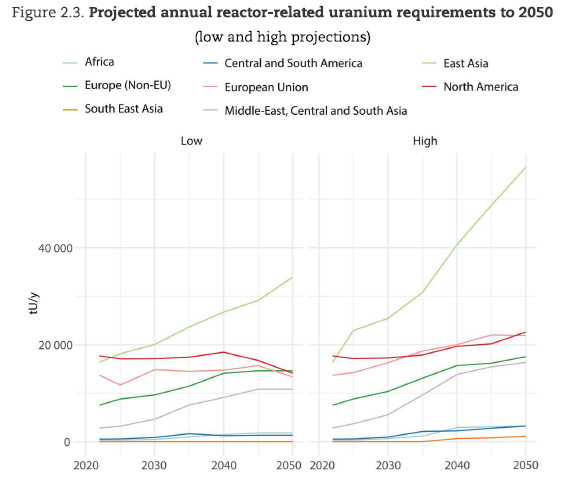
And, Canada may not have to foot the bill alone. The NEA anticipates significant increases in demand in several regions of the world (see below), many of which include Canadian allies who may be persuaded to invest in exchange for priority access to enriched uranium. China and/or the U.S. may be interested in such deals, too.
No matter what Canada decides on this issue, it should be a topic for reconsideration and informed debate. Governments can’t afford to casually hand over another means of foreign coercion in this post-rupture world.